A strong reoasn for not being able to concentrate is not having a strict plan of what to do when I lose track of what I'm doing, I completely forget what I'm doing and start thinking of other things (or nothing, as you say).This is my study technique:1. read all slides/notes x 22. highlight important parts of the notes3. write a summary of the notes4. highlight those notes (optional if you don't have much time)5. do sample/past exams (if they're provided)Making a timetable is good too, like one hour of a certain subject per day is nicer than studying everything you've learned in one day! As for music, find something which helps you concentrate rather than distracting you. Sorry if I sound super bossy, I used to be like that at the beginning of uni and screwed up, so I know how you feel and want to help! Good luck
Drivers most at risk from distractions outside car
By: Drivers.com staff
Date: Sunday, 03. September 2006
Each year an estimated 284,000 distracted drivers are involved in serious crashes, according to a new study by the University of North Carolina Highway Safety Research Center funded by the AAA Foundation for Traffic Safety. A detailed summary of the report is available on the AAAFTS site. Perhaps the most surprising finding of the research is that objects and events outside the car were such a major source of distraction.
"We found that 15 percent of drivers in the study were not paying attention and just over half of these (8.3 percent) were distracted by something inside or outside the vehicle," said Dr. Jane Stutts, manager of epidemiological studies at the UNC center and author of the study. When drivers with unknown attention status were removed from the data, the percentage of distracted drivers rose to 12.9 percent.
The study found that drivers were most often distracted by something outside their vehicle (29.4 percent) followed by adjusting a radio or CD player (11.4 percent). Other specific distractions included talking with other occupants (10.9 percent), adjusting vehicle or climate controls (2.8 percent), eating or drinking (1.7 percent), cell-phone use (1.5 percent) and smoking (0.9 percent). However, percentages should be considered very rough estimates, which are likely biased by underreporting.
What Distracts Drivers?
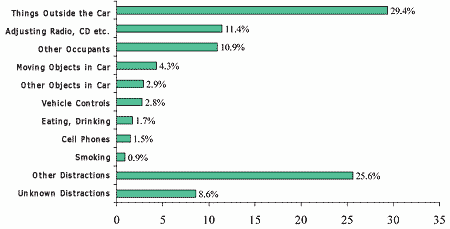
"Different age groups appear to be distracted by different things," Stutts said. Drivers under 20 were especially likely to be distracted by tuning the radio or changing CDs, while young adults (ages 20 - 29) seemed to be more distracted by other passengers. Drivers over 65 were more distracted by objects or events happening outside the vehicle. Most of the distracted drivers were male (63 percent), in part because as a group males drive more than females and are more likely to be involved in serious crashes.
Atention status of drivers in crashes
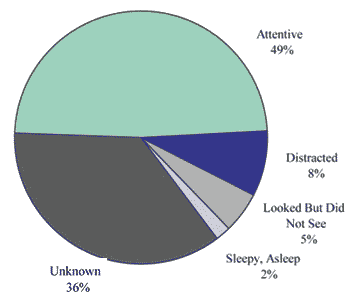
Researchers used the National Highway Traffic Safety Administration's Crashworthiness Data System (CDS) for the study. The CDS examines a sample of approximately 5,000 crashes a year in which at least one vehicle was damaged enough to require towing. Federal investigators collect detailed information about each crash, including examination of the vehicle and crash scene and interviews with drivers and witnesses. The UNC center's study used data from 1995 through 1999 and included 32,303 vehicles.
Outline of results, methodology, and data limitations
Study methodology
The study analyzed data from the National Highway Traffic Safety Administration's Crashworthiness Data System (CDS). This data includes only information on crashes in which at least one vehicle was damaged severely enough to require towing from the scene. CDS crash investigators collect data from medical records, visits to the crash scene, examination of the vehicles, and interviews with drivers and witnesses. It is important to note that the CDS analysis for this study was vehicle-based rather than crash-based, and thus almost certainly understates the role of driver distraction in crashes.
In 1995, CDS investigators began describing the attention status of the driver
at the time of the crash. Specific categories of distraction are identified
and coded. The current study used data from 1995 through 1999, a total of 32,303
vehicles. Some CDS reports also have narratives that describe circumstances
of the crash; this information was included in the study.
The specific sources of distraction among distracted drivers were, in order
of frequency:
Specific Distraction |
% of Drivers |
Outside person, object, or event |
29.4% |
Adjusting radio/cassette/CD |
11.4% |
Other occupant |
10.9% |
Moving object in vehicle |
4.3% |
Other device/object |
2.9% |
Adjusting vehicle/climate controls |
2.8% |
Eating and/or drinking |
1.7% |
Using/dialing cell phone |
1.5% |
Smoking related |
0.9% |
Other distractions |
25.6% |
Unknown distraction |
8.6% |
Driver attention status for all crashes, based on weighted data from the NHTSA's Crashworthiness Data System (Listed next to the percentages are the 95% confidence intervals.) |
|
Attentive |
48.6% 5.4% |
Distracted |
8.3% 1.2% |
Looked but did not see |
5.4% 1.4% |
Sleepy or fell asleep |
1.8% 0.8% |
Unknown/no driver |
35.9% 5.5% |
Study/Data limitations
Missing data: The CDS data has a high percentage of "missing," "unknown," and "other" data. In spite of extensive investigations, driver attention status is "unknown" for almost 36 percent of the drivers. In addition, 34 percent of the drivers known to be distracted were coded as "other" or "unknown" distractions. Thus, present estimates for known distracting events probably understate their true magnitude.
Sample size: Because of small sample sizes, the data have large standard errors when weighted to reflect national estimates. For example, the estimates for cell phone use are based on only 42 reported cases.
Exposure data: It is not known how much time drivers engage in various distracting activities, so relative risk cannot be determined. The CDS data only provides information on how often each behavior is a factor in crashes. More research is needed to document the frequency, intensity, and consequences of real-world driver distraction. Understanding driver distraction is especially important in light of new in-vehicle technologies.
The University of North Carolina Highway Safety Research Center conducts interdisciplinary research aimed at reducing deaths, injuries and related societal costs of roadway crashes in North Carolina and the nation. The Center's research addresses crashes involving motor vehicles, bicyclists and pedestrians, and takes into account the various human, vehicular, roadway, and environmental components of these risks.
The AAA Foundation for Traffic Safety is an independent, publicly funded,charitable research and educational organization founded by the American Automobile Association in 1947. The AAA Foundation's mission is to prevent traffic deaths and injuries by conducting research into their causes and by educating the public about strategies to prevent crashes.
Further comments to this article have been disabled.
All Comments (7)
Showing 1 - 7 comments
 Padiga,
saintbumper,
STOPS rear-end collision damage caused by Tailgaters, Uninsured Motorists, Bumper To Bumper Traffic, Distracted Drivers, Inattentive Cell Phone Users, Drivers With Poor Judgment, Text Messengers And Lousy, Stinking Parallel Parkers.
http://www.superbumper.com
ammy,
When I'm drivig I get ditracted by huge vehicles!!!!!!! Then the other thing i hate is the way people drive now a days! I also hate it when there is traffic jam people start to honk the horn, dang i hate that........!What would you do in a situation like that??????????
Tom,
I would like to know some ideas on how to prevent distractions. How to warn people that multitasking while driving is dangerous.
Patty,
Yes I would like to know more about pet distractions
jeffrey grant,
Im looking for data that reflects how "pet distractions" contributed to accidents or possible accidents.
jnsgrant03@knology.net
Tony Cece,
More often than aware drivers aren't focused on the true dangers of driving.Everything becomes a distraction once the vehicle is in motion.Consequences are not the prime state of being,over all awareness is even a risk.To many variables come into play,many factors never come into thought.All of these facts become instant distractions.We will be sending you something that can help.